
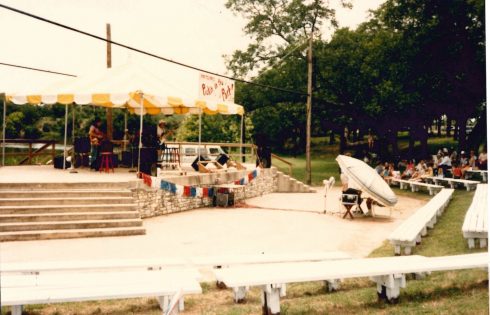
A legacy is defined as “something that is handed down from one period of time to another period of time; something we inherit from past generations and pass to our future generations.” Johnson Park, named after the founder of Marble Falls, General Adam Rankin Johnson, has been in existence since the town was founded in 1887. The plat of the original township shows Johnson Park designated as a community park at that time. Research indicates that the park area was being used for community functions and events as early as 1888, when the park was used as the first meeting place for the First Baptist Church. The Park was even home to many during the Great Depression of the 1930s when families looking for work lived in tents throughout the park. Johnson Park has been the place for virtually every community event and countless social gatherings over the last 128 years. Today, the Park is still used by the First Baptist Church and other churches in the community, along with a variety of other community functions and celebrations such as family reunions, weddings, picnics, baptisms, festivals, carnivals, cook-offs, summer camps, cultural events, scouting events, beauty pageants, community garage sales, music events, sporting events, and fund raising events. Johnson Park is a place of relaxation, recreation, celebration, competition, conservation, and preservation. It is also a place of reflection – adorned with various granite memorial benches, monuments, and markers for loved ones and those who served our Country.
As a young man, Adam Rankin Johnson traveled through this treacherous Central Texas territory, working as a surveyor and transporting goods to isolated supply stations in the 1850’s. In 1854, Johnson rode down the Colorado River from Fort Mason to see the “great falls,” now covered by Lake Marble Falls, and visualized a great manufacturing city powered by the falls. He acquired land certificates for the area and was ready to settle here in 1861, when he discovered the certificates were worthless.
Instead, Adam Rankin Johnson settled with his wife, Josephine, in Burnet and soon joined the Confederate Army. Attaining the rank of General, Adam made quite a name for himself. He was known as “Stovepipe” Johnson for his American Civil War escapades – which included duping the Union army in Newburgh, Indiana, with fake “cannons,” constructed from stovepipes and wagon wheels – but was tragically blinded by a rifle ball. He was released after being held captive by the Union army for six months and sent home to Burnet where he spent the next thirteen years working at a land office. Johnson relied on his superb memory to direct his young son how to drive him through the territory in search of land deals.
General Johnson followed through on his vision of creating a vibrant town and facilitated the construction of a railroad to nearby Granite Mountain in 1884, then (with ten partners, including one son, one nephew and two sons-in-law) platting the town site and selling lots, beginning July 12, 1887. The lots were priced ranging from $75 to $750. The town soon became a thriving cotton center, to be known as “The Blindman’s Town.” A plat of the original township signed by General Johnson, which can be viewed at the Burnet County Clerk’s Office, shows Johnson Park and its central location within the town.
Johnson built a fine home, a college (now home of the Falls on the Colorado Museum), and a large factory near The Falls. The town grew to a population of 1,800 within ten years and was incorporated in 1907. The growth was
celebrated in Johnson Park for a number of years with a reunion of the Southwest Texas Old Settlers, according to a news article in the Marble Falls Messenger on July 15, 1909.
In the book titled “The First One Hundred Years, The Story of the First Baptist Church of Marble Falls, Texas,” noted historian Don Dilmore cites a letter written by Mrs. Brandt Badger in 1888, in which she describes how a narrow gauge rail line known as the “Wilkie Narrow Gauge” had been dismantled with the old railroad ties being stacked in Johnson Park. According to Mrs. Badger’s letter, the ties provided the seating for the first meetings of The First Baptist Church of Marble Falls, while the members made arrangements to have a permanent building constructed over the next several months.
Marble Falls made history in 1917 by electing Ophelia Crosby “Birdie” Harwood as the nation’s first woman mayor, three years before women were allowed to vote. Birdie Harwood’s campaign platform included a promise of graded and lighted streets as well as lighting for the Park. During her term as Mayor, she invested significant resources to cleaning and improving the Park, painted an existing park pavilion, and leased an additional 19 acres of park land.
Information and documentation from the 1930s and 1940s is limited, possibly due to hard times related to the Great Depression and World War II. Johnson Park served as a home for many living in tents and looking for work in the 1930s. According to 93-year-old resident, Opal Walker Lawson, the pecans from the trees in the Park provided a source of survival income for families needing food and other necessities. She tells a story of her parents sending her to town to get some baking powder, stopping in Johnson Park to pick up enough pecans to sell for the money to purchase the baking powder. Despite hard times, Johnson Park continued to be an important place of relaxation, recreation, and celebration during a very difficult period of history.
When the Max Starcke Dam was completed in 1951, the falls which had given the town its name were submerged under the new Lake Marble Falls. The City Council authorized the Pedernales Electric Cooperative to install new electric lighting in the Park and a concrete low-water crossing was constructed over Backbone Creek in 1954, replacing the bridges and gravel crossings that washed away each time the creek flooded. The current bridge leading into Johnson Park replaced the low-water crossing in 1967.
In 1966, the Jaycees ordered swing sets for the Park; and, the City Commission passed a motion to appoint the Jaycees as the first Parks and Recreation Committee for the City of Marble Falls. Then, in 1971 the Girl Scouts added to the playground area as part of a public service project; today, meet in a scout hut, also located in Johnson Park, which was passed along from the Boy Scouts. In 1973, the second annual Howdy-Roo Chili Cook Off was held in Johnson Park. The Howdy-Roo, which is a regional qualifier for the internationally famous Terlingua Chili Cook Off, has been held in the park every year since, drawing hundreds of contestants and tourists alike. Another long standing event is Lakefest. Drag boats and crews have staged and set up pits in Johnson Park the first week of August each year since 1992.
While the town’s economy struggled through the drought of the 1950s, a new economy based on tourism and retirement began to grow in the 1970s. During the last thirty years, Marble Falls has grown into the retail and recreation center for the Highland Lakes area, and continues to attract tourists, retirees and new businesses.
Through it all, Johnson Park has been an integral part of Marble Falls’ history and remains at the heart of the City – where memories are made and shared. The placement and preservation of an old 1930s Pony Truss-style bridge moved from the Gridiron Branch of Double Horn Creek in Central Burnet County to Johnson Park (now known as Madolyn’s Crossing) as a place of preservation represents an appreciation of the history of Johnson Park. Recent improvements including a recycled wastewater irrigation system, hike and bike trail, land purchases adjacent to the Park, and the development of a tree care and maintenance plan for the 100 plus year old pecan trees, indicate an understanding of the value of Johnson Park to the identity of the community, to the quality of life, and to the future of Marble Falls.
To Marble Falls, Johnson Park is a true Lone Star Legacy. It is the icon of Marble Falls’ Vision – “Building a Better Community – Preserving the Foundation of the Past.”
References